

Don't Fry Your Stompboxes
I love a good stompbox.
There’s something really wonderful about these tiny metal boxes and the people who dream them up. Some are built by massive, faceless companies, others by a solo engineer tinkering away in their garage, all trying to create a sound nobody’s ever heard before.
And somehow, decades into the history of electric music, people are still coming up with completely new ways to manipulate sound. That’s pretty incredible when you think about it.
If you’ve ever wandered through the Stompbox Booth organized by Delicious Audio, you know exactly what I’m talking about. Their Stompbox Booth at NAMM is one of those magical corners of the music industry that still exist, where boutique builders and established brands come together to show off their latest creations, and it’s not just about how much money you have to throw at it.
It’s a fantastic idea, rather than asking every little pedal company to spend a fortune exhibiting at NAMM, Delicious Audio creates a shared space where builders can put their gear in the hands of musicians. Because the demos happen through headphones, you can actually hear what these wild little inventions do without competing with the roar of the convention floor, a nice, quiet, time with your (soon-to-be) favorite pedals.
Really, it’s exactly the kind of community-driven innovation we love here at Tonic Audio.
But here’s something I’ve been thinking about as we’ve been developing Grid, our latest hardware product.
Every one of these wonderful little stompboxes needs electricity. And for all the creativity that’s gone into designing them, powering a bunch of them together can still be a giant pain in the ass. It’s unsexy to think about the power brick part of a shiny new stompbox. But it can be critical.
Different voltages. Different current requirements. A spaghetti monster of cables running underneath your pedalboard. And if you really nerd out in the pedal world, you start going down the rabbit hole of voltage sag.
But if you get something wrong, you might fry that beautiful boutique pedal that you just spent $300 on.
So let’s talk about a few simple rules that can save your stompboxes from an untimely death.
Rule #1: Voltage matters. A lot.
Most stompboxes run on 9 volts DC. But most is doing some pretty heavy lifting in that sentence.
There are pedals that need 12V, 18V, and some even 24V. Some pedals can operate at multiple voltages, and some absolutely cannot.
Here’s the thing: voltage isn’t something you want to guess about.
If you’ve got a 9V stompbox and plug it into an 18V power supply, you could damage the internal power circuitry. Maybe it has some protection built in, maybe it doesn’t. Do you really want to find out?
There are some interesting exceptions, such as certain overdrives are specifically designed to run at either 9V or 18V. Giving them more voltage can increase their headroom, meaning they handle a stronger signal before clipping, and sometimes can be cleaner. (Why you’d want an overdrive to be cleaner is beyond us!) Depending on the circuit, that might give you a richer, more open sound.
Cool! But it’s only cool if the pedal was designed for it, and that’s the sound you’re going for.
The takeaway is, check the voltage requirement printed on your stompbox or listed in the manual. Match it exactly unless the manufacturer explicitly says otherwise.
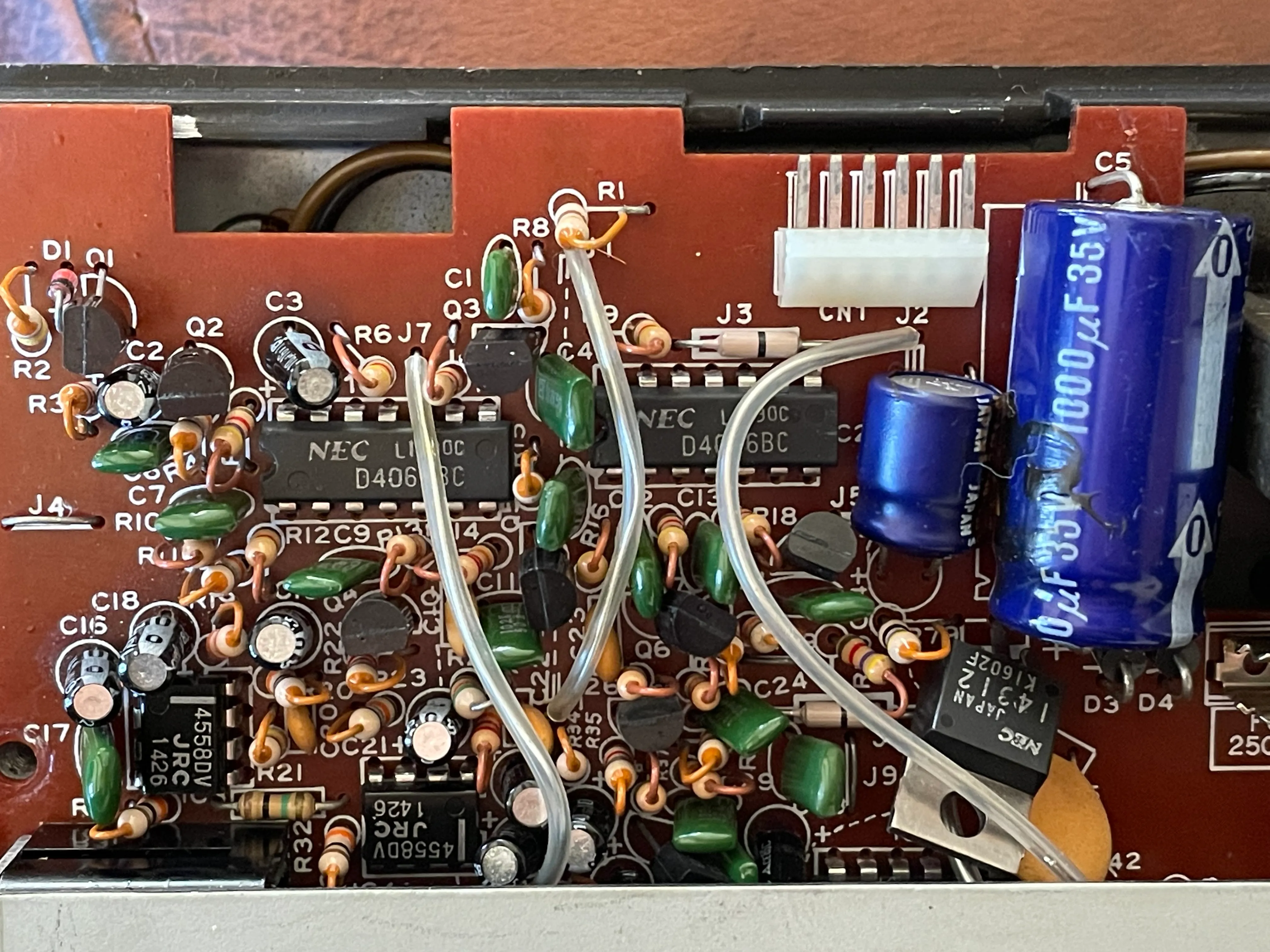
And while you’re checking, make sure it specifies DC or AC power. Those are two very different things. A couple of old pedals run on AC power. And even fewer can actually run on DC at a higher voltage even though they advertise AC. Ask Allie sometime about her early 1980s Yamaha AD-10 bucket brigade delay she converted from AC to DC, shown below.
Rule #2: Polarity is not a suggestion
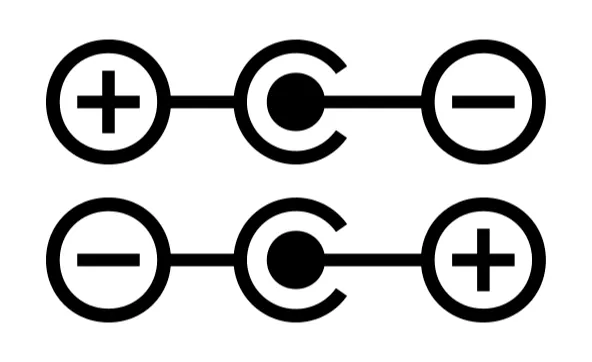
This one is sneaky. Most modern stompboxes use what’s called center-negative polarity. That means the center contact of the barrel connector is negative, and the outside is positive.
Simple enough, right?
Except not every pedal follows that convention.
Some vintage effects and specialty stompboxes use different polarity arrangements. And just because a power connector fits into the jack doesn’t mean it’s delivering electricity the right way.
Get the polarity wrong, and you can damage the pedal. Some have reverse-polarity protection, but I wouldn’t count on it. Still others (see Allie’s AD-10 mod photo above) can take either polarity due to the magic of diode rectifiers, but they’re pretty rare.
Look for the little polarity diagram on your pedal or its power adapter. It tells you whether the center contact is positive or negative. They look like this:
The takeaway: Match the polarity. Every time. Seriously. Take the extra ten seconds.
Rule #3: Your stompbox can have more amperage available than it needs.
This is where people get confused, and I get it. It threw me a bit too.
I just told you that too much voltage can damage your stompbox. So naturally, you might assume that too much amperage is equally dangerous. But that’s not how it works.
Amperage is the amount of electrical current your stompbox draws, usually measured in milliamps (mA). Because of this, some people call this “current” instead of “amperage”, but they’re the same thing.
Let’s say you’ve got a little analog overdrive that draws 20mA. Your power brick has a 9V output capable of supplying 500mA.
Can you plug it in?
Absolutely.
The pedal only draws the current it needs. The power supply’s 500mA rating is its available capacity, not an amount it forces into your stompbox. So it will sip 20mA from that 500mA, and theoretically that power supply could power other pedals with its leftover 480mA.
Now let’s flip that around. You’ve got a fancy digital reverb that needs 300mA, but you’ve plugged it into a power output rated for only 100mA.
Now you’ve got a problem.
The pedal might not start. It might reboot randomly. It might introduce noise or behave unpredictably. And an overloaded power supply could overheat or shut down.
None of those things are particularly helpful when you’re about to start a set, realized you left a power supply at home and ask to borrow another band’s wall wart for your pedal.
The takeaway: Your power supply needs to provide at least as much current as your stompbox requires. More capacity is fine. Less is not.
Three rules. Thousands of stompboxes. One big mess of cables.
So there you have it.
- Voltage: Match the pedal’s specified voltage.
- Polarity: Make sure positive and negative are where they’re supposed to be.
- Amperage: Make sure there’s enough available current.
Three pretty straightforward rules.
But here’s where it gets a bit finicky. The more stompboxes you add to your rig, the harder managing all of this becomes.
One pedal needs 9V at 20mA. Another needs 9V at 300mA. That fancy digital processor wants 500mA. Maybe you’ve got an 18V overdrive in the mix. Maybe you really want that Fuzz Face to get 7 volts instead of 9 volts so you get that sweet sweet voltage sag.
And suddenly, powering your creative setup starts feeling like an electrical engineering project.
There are some excellent power supplies out there. Companies like Voodoo Lab have been helping musicians solve these problems for years. But as live rigs become more sophisticated, we think there’s still plenty of room to rethink how musicians manage power. Especially when it comes to adding new, more modern devices that require more power.
Which brings me to Grid.
Why we’re building Grid
At Tonic Audio, we’ve spent the last several years thinking about how technology can make musicians’ lives easier.
Our resident engineer and co-founder, Allison, is constantly dreaming up ideas for hardware that solves the annoying little problems musicians encounter every day. Mike and I are usually more than happy to encourage her.
Grid grew out of that process.
We started asking ourselves what a modern power system for live musicians could look like. Not just another box with a bunch of jacks on it, but something designed around the way people actually build, modify, and perform with their rigs. Something they can rely on, and trust.
We’re developing Grid around the idea that musicians should spend less time wrestling with equipment and more time making music.
We’re particularly interested in flexibility, thoughtful design, and features that make managing a complicated live setup a little less complicated.
Because whether you’re a guitarist with three favorite stompboxes or a synth musician with a table full of gear, the technology should work for you. Not the other way around.
And honestly, if we can help a few musicians avoid frying their favorite fuzz pedals along the way, that’s a pretty good bonus.
We’re getting ready to bring Grid to Kickstarter on April 27, 2027.
If you’re interested in what we’re building, we’d love to have you along for the ride.
Meet Grid and join our Kickstarter VIP list
Made with love in Reno and Montana.